Recent large-scale Vision Language Action (VLA) models have shown superior performance in robotic manipulation tasks guided by natural language. However, current VLA models suffer from two drawbacks: (i) generation of massive tokens leading to high inference latency and increased training cost, and (ii) insufficient utilization of generated actions resulting in potential performance loss. To address these issues, we develop a training framework to finetune VLA models for generating significantly fewer action tokens with high parallelism, effectively reducing inference latency and training cost. Furthermore, we introduce an inference optimization technique with a voting ensemble strategy to combine current and previous action predictions, improving the utilization of generated actions and overall performance. Our results demonstrate that we achieve superior performance, achieving significantly higher success rates and 39× faster inference than OpenVLA with 46 Hz throughput on edge platforms, demonstrating practical deployability.
VOTE policies in simulation, with the instruction each episode was given.
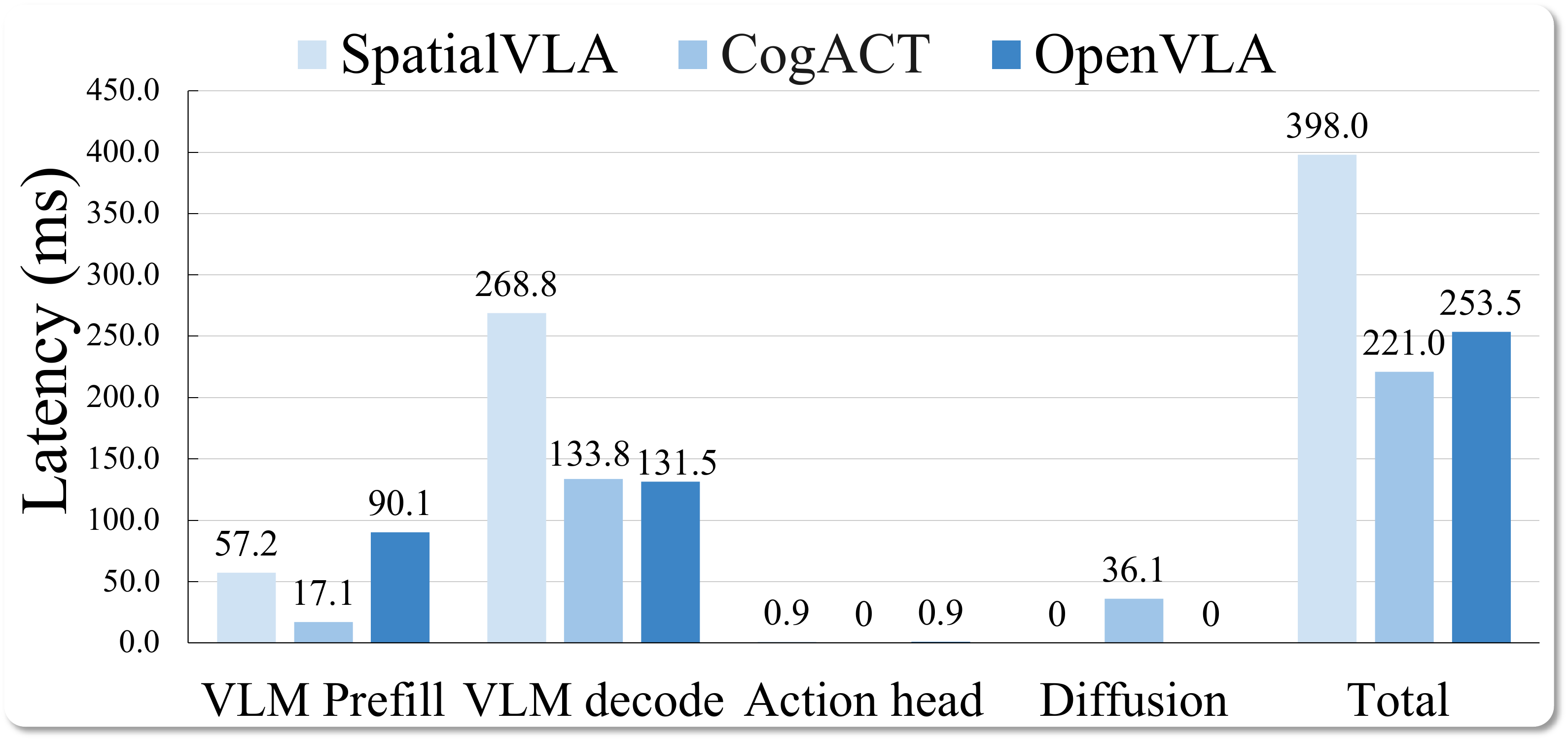
In current VLAs the VLM backbone dominates action latency: decoding the action tokens takes at least half of the total time for SpatialVLA, CogACT and OpenVLA, CogACT adds a diffusion head on top, and SpatialVLA feeds extra 3D visual tokens into a longer input sequence. Many output tokens also mean padding as many empty action embeddings during training.
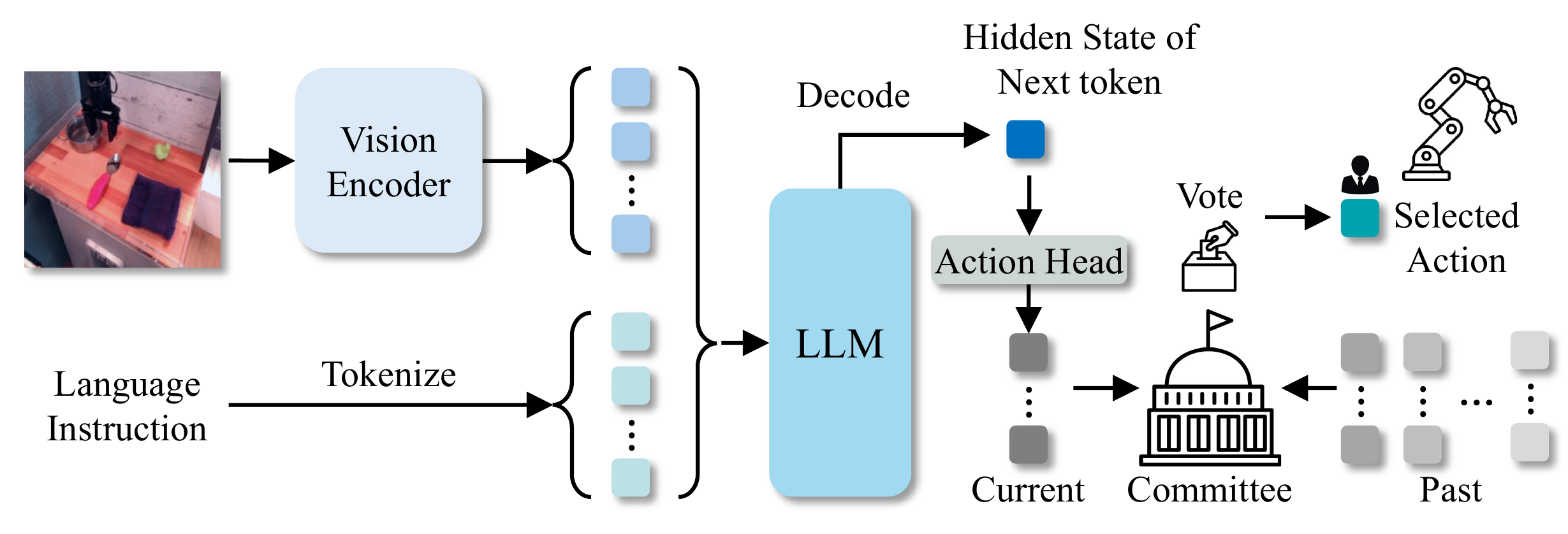
VOTE adds a special token <ACT> to the tokenizer and appends it to every instruction as the target label. After one forward pass, the final-layer hidden state of <ACT> goes to an MLP action head: it downsamples the hidden state from 4096 to 1024 dimensions and passes it through 4 bottleneck blocks, each projecting back up to 4096 and down to 1024, to predict a chunk of continuous 7-DoF actions (end-effector translation, rotation and gripper). Training combines an L1 loss on the actions with the token-level cross-entropy. No action tokenizer is needed, and only one token is generated per chunk.
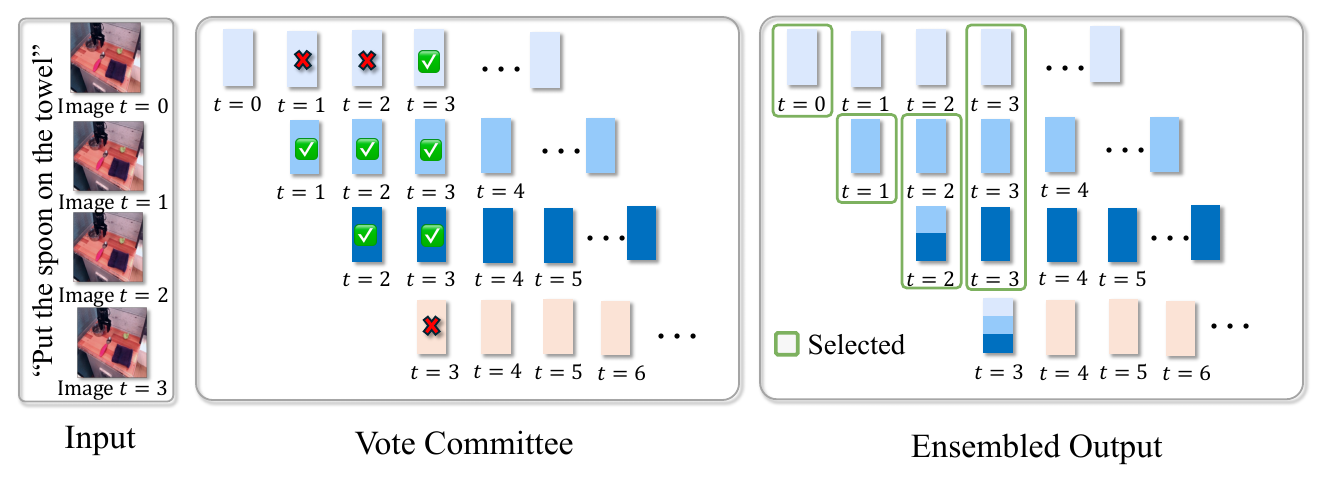
Each inference predicts several future steps, so at step t the robot also holds predictions for t made at earlier steps. VOTE puts the current prediction and the last K predictions for step t into a committee and splits it by cosine similarity to the current prediction (threshold τ = 0.5). The larger side wins, and the executed action is the mean of its members. Because the split is made relative to the newest prediction, it always counts as one vote for agreement, while modes that disagree with the majority are filtered out instead of being averaged in. We use K + 1 = 8.
SimplerEnv WidowX (average of four tasks, 24 trials each) and LIBERO (chunk 8). Success rate (%); latency on an RTX A6000.
| Method | SimplerEnv WidowX | LIBERO | ||||||
|---|---|---|---|---|---|---|---|---|
| Avg. | Latency (ms)↓ | Speed↑ | Spatial | Object | Goal | Long | Avg. | |
| RT-1-X | 1.1 | — | — | — | — | — | — | — |
| Octo-Base | 16.0 | — | — | — | — | — | — | — |
| Octo-Small | 30.0 | — | — | — | — | — | — | — |
| OpenVLA | 1.0 | 240 | 1.0 | 84.7 | 88.4 | 79.2 | 53.7 | 76.5 |
| RoboVLM | 31.3 | — | — | — | — | — | — | — |
| Diffusion Policy | — | — | — | 78.3 | 92.5 | 68.3 | 50.5 | 72.4 |
| Octo | — | — | — | 78.9 | 85.7 | 84.6 | 51.1 | 75.1 |
| TraceVLA | — | — | — | 84.6 | 85.2 | 75.1 | 54.1 | 74.8 |
| π0 | 27.1 | — | — | 96.8 | 98.8 | 95.8 | 85.2 | 94.2 |
| π0-FAST | 32.1 | 470 | 0.5 | 96.4 | 96.8 | 88.6 | 60.2 | 85.5 |
| SpatialVLA | 42.7 | 400 | 0.6 | 88.2 | 89.9 | 78.6 | 55.5 | 78.1 |
| CogACT | 51.3 | 220 | 1.1 | — | — | — | — | — |
| OpenVLA-OFT | — | — | — | 96.2 | 98.3 | 96.2 | 90.7 | 95.3 |
| VOTE | 58.3 | 78 | 3.1 | 98.8 | 99.8 | 97.6 | 95.6 | 98.0 |
Speed is relative to OpenVLA. — = not reported. ■ best ■ second best in each column.
Inference on a desktop GPU and on an edge device.
| Model | Chunk | NVIDIA RTX A6000 | NVIDIA Jetson AGX Orin | ||||||
|---|---|---|---|---|---|---|---|---|---|
| Latency (ms)↓ | VRAM (GB)↓ | Throughput (Hz)↑ | Speedup↑ | Latency (ms)↓ | VRAM (GB)↓ | Throughput (Hz)↑ | Speedup↑ | ||
| OpenVLA | 1 | 240 | 14.35 | 4.2 | 1.0 | 836 | 14.35 | 1.2 | 1.0 |
| SpatialVLA | 4 | 400 | 7.82 | 10.1 | 2.4 | 1949 | 7.82 | 2.1 | 1.7 |
| CogACT | 16 | 220 | 29.33 | 72.4 | 17.7 | — | OOM | — | — |
| VOTE | 8 | 78 | 14.40 | 102.6 | 24.4 | 346 | 14.40 | 23.1 | 19.3 |
| VOTE | 16 | 78 | 14.40 | 205.2 | 48.8 | 346 | 14.40 | 46.2 | 38.6 |
Latency = time to generate one action chunk; throughput = actions per second; each model queried 100 times with a 224×224 image. Speedup is relative to OpenVLA. OOM = out of memory.
Action ensemble strategies on SimplerEnv. Success rate (%).
| Strategy | Google robot VM | Google robot VA | WidowX | Average |
|---|---|---|---|---|
| None | 60.9 | 56.3 | 24.0 | 47.1 |
| Temporal | 70.5 | 60.3 | 30.2 | 53.7 |
| Adaptive | 71.9 | 60.3 | 49.0 | 60.4 |
| Average | 72.1 | 59.6 | 53.2 | 61.6 |
| Ensemble voting | 74.9 | 60.2 | 58.3 | 64.5 |
VM = Visual Matching, VA = Visual Aggregation. Average averages all historical predictions; Temporal is the ACT temporal ensemble; Adaptive is CogACT's adaptive ensemble. ■ best ■ second best in each column.
Action head architecture and chunk size on LIBERO. Success rate (%).
| Action head | Spatial | Object | Goal | Long | Average |
|---|---|---|---|---|---|
| Isotropic, chunk 8 | 98.0 | 99.5 | 96.0 | 94.0 | 96.9 |
| Isotropic, chunk 16 | 96.0 | 98.5 | 94.0 | 91.0 | 94.9 |
| Bottleneck, chunk 8 | 98.8 | 99.8 | 97.6 | 95.6 | 98.0 |
| Bottleneck, chunk 16 | 97.6 | 97.8 | 96.8 | 93.8 | 96.5 |
Isotropic keeps every linear layer at the 4096-d hidden size; Bottleneck is VOTE's 4096→1024 head. ■ best ■ second best in each column.
@inproceedings{lin2026vote,
  title     = {VOTE: Vision-Language-Action Model Optimization for Real-Time Robotic Manipulation},
  author    = {Juyi Lin and Amir Taherin and Arash Akbari and Arman Akbari and Lei Lu and Guangyu Chen and Taskin Padir and Xiaomeng Yang and Jayanth Srinivasa and Xue Lin and David Kaeli and Yanzhi Wang and Pu Zhao and Xuan Shen},
  booktitle = {International Conference on Artificial Neural Networks (ICANN)},
  year      = {2026},
  eprint    = {2507.05116},
  archivePrefix = {arXiv},
  url       = {https://arxiv.org/abs/2507.05116}
}